We are working on yet more multiplication around here. Now that the weather is so amazing, we’ve taken some of our learning outside. This week we practiced multiplication with outdoor arrays.

We are working on yet more multiplication around here. Now that the weather is so amazing, we’ve taken some of our learning outside. This week we practiced multiplication with outdoor arrays.
My son loves maps, especially the ease of browsing places and seeing what they look like on Google Maps. Since, in his geology class, he has been learning about mountains and volcanoes on the earth’s surface, we played a matching game using some of the landforms he has come across. I gave him the names of some of the global landforms he has encountered in his studies and asked him to figure out which continent they are on!
Continue reading

My son is currently taking Geology from Athena’s Academy, using the Focus on Geology textbook from Real-Science-4-Kids. It’s labeled a Middle School textbook, and his class is using it as a nice overview of the various concepts of geology. Their online class spent extra time learning about volcanoes, earthquakes and other ways the earth’s crust changes. They’ve spent time learning about rocks and the layers of the earth. Now he’s moving in to the other aspects of the earth, such as the atmosphere and now the biosphere. To review the various biomes on earth, I made biomes game cards for us to play with and to spark discussion.
Continue readingMultiplication is my third grader’s nemesis this year. I remember the dreaded weekly multiplication tests from my own third-grade year. So, any way we can make practicing the times tables into a game, the better!

Raisin actually helped me figure out how to make this baseball multiplication game. We use the ten-sided die and baseball equations to practice solidifying our multiplication facts.
The King is up at bat, with two outs! Will he get a home run this time?
Continue reading My daughter Strawberry loves finding her name on papers and notes around the house. Whenever she sees a “C”, she thinks it must be her name (her real name begins with “C”). She also recognizes “Mom” and “Dad,” and now she’s finding her brother’s name. (His name starts with a “P” and she loves to say “Popcorn”! when she finds his name.) This week I decided to take our super-fun Leap Frog dominoes and make a game for name recognition with dominoes, using the names of our family members.
Each of the included dominoes cards has about five matches, so this was perfect, since our family has five members in it! Continue reading
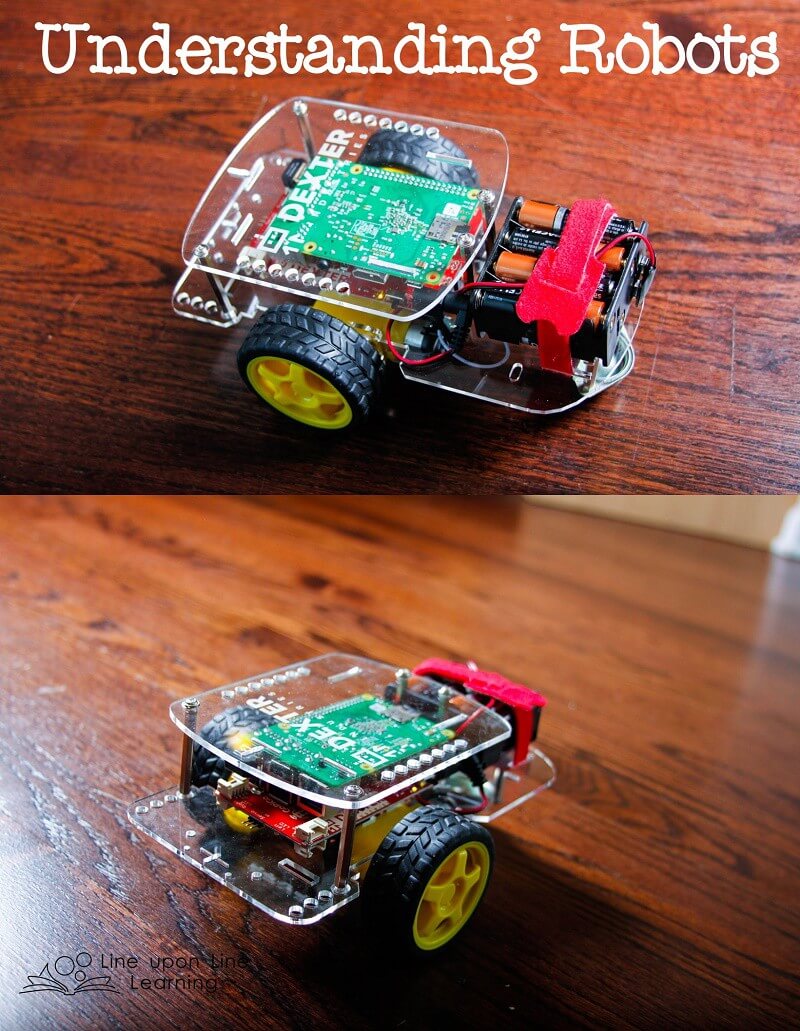 My son loves computer programming using Scratch, and he has always loved using Snap Circuits to create his own electrical circuits. As Christmas approached last year, I wondered what I could get him that would truly meet his current needs and interests, as well as being something he can grow with this year. Due to my husband’s own insistence that I focus on STEM concepts with my son, I was drawn to the concept of a robot.
I decided to go with the GoBox, which packs the GoPiGo robot car (including a Raspberry Pi) with a monthly kit of a new challenge or sensor to add to the robot. As we pondered what to do for last weeks’ science fair, we decided to get even more familiar with the robot. In addition to programming the robot car to go around the room and return to start, we made a presentation about what robots are and are not. Further, after reading some fun stories about robots, we researched and discussed what a robot really is and how the stories were accurate and then how the stories bent toward fantasy. Understanding robots is much more fun with a robot to program yourself! Continue reading
My daughter loves making noise and she is fascinated by musical instruments. When I saw a Toob of musical instruments, I knew she’d love to play with them. Hence, here’s my instruments busy bag. It’s not a noisy one, such as you would expect. Rather, it is a quiet busy bag that requires her imagination to make the music. There is a time and a place for the noisy instruments, but today’s busy bag includes matching small, model instruments to instrument cards. Continue reading
“You can’t erase pen!” my daughter said as I drew five small circles on the paper and poured the small erasers out on the table. What could we possibly be up to! She loved the mystery.
I made this activity into a tweezer fine motor activity. Strawberry was delighted to find her actual task was an eraser sort challenge: Could she sort the small erasers into the correct circle using only the alligator tweezers?
Continue reading

My son is taking an online Geology class this winter/spring. Recently, his class talked about core sampling, and I was intrigued by the concept. This week we replicated core sampling with play dough, and it gave us a lot to talk about. What we can learn from what is under the surface of the earth, simply by taking a sample of one spot?
Continue readingI’m quickly finding that my preschooler needs hands on interactive fun. When she gets home from preschool it’s a little bit before lunch time, so without an activity, she’ll whine until the food is served. This week’s favorite activity was a color mixing fine motor water activity using food coloring and a kid-sized dropper.  Continue reading