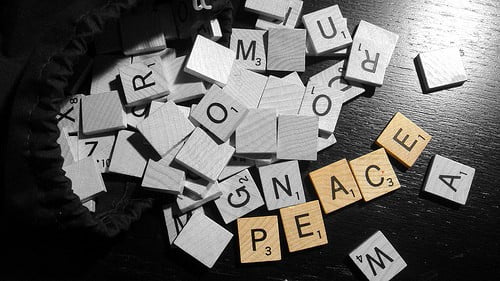
As I gathered with family for Christmas, one word kept going through my mind: PEACE.
This seemed strange to me. Continue reading
As I gathered with family for Christmas, one word kept going through my mind: PEACE.
This seemed strange to me. Continue reading
Here are some inspiring quotes I found when I was preparing for my enrichment night presentation.
D&C 88:118 “And as all have not faith, seek ye diligently and teach one another words of wisdom; yea, seek ye out of the best books words of wisdom; seek learning, even by study and also by faith.”
I love this commandment! But I realize it says seek, not read. We should be learning, not just page-turning, as I like to do.
“[Quotes D&C 88:118] Surely, such books must first include the scriptures. Next must be the words of prophets, seers, and revelators.”
–President Ezra Taft Benson, Ensign, Sept 1988
I found myself reading some of the Mormon blogs a few months ago — you know, the forums where individuals analyze general conference talks and discuss how they can personally apply them to their lives. As I began to spend my time doing that, I realized that I should be spending my time actually reading the words of the prophets. That is where the spirit is to be found, not in others’ analyses: I need to come to my own understanding, with the spirit to guide me. I should spend more of my time studying the scriptures and the words of the prophets, not necessarily what other people say the scriptures and the prophets say. There is a difference.
With the abundance of books available today, it is a mark of a truly educated man to know what not to read. Of the making of books there is no end. In our reading, we would do well to follow the counsel of John Wesley’s mother: “Avoid whatever weakens your reason, impairs the tenderness of your conscience, obscures your sense of God, takes off your relish for spiritual things, increases the authority of the body over the mind. The fact that a book or publication is popular does not necessarily make it of value. The fact that an author wrote one good work does not necessarily mean that all his books are worthy of our reading. Many novels and modern publications are corrupters of morals or distorters of truth.
–President Benson, Ensign, Sept 1988 (emphasis added)
There is a lot of trash out there. I’s disappointing when that is what wins the awards and praise, but sometimes it happens. I guess that’s the difference between things of the world and things of God. Just because I like one novel by a Nobel prize-winning author does not mean I should read others of theirs: some of them are just bad!
I read a book for a book club and I dismayed that it had a lot of “bad” scenes in it. I felt like I should finish it because the book club was going to discuss it. But I’ve decided I’m not going to do that again: it it’s bad, I won’t read it, even if it is popular or on an award-winning list or on the book club list.
Often when we hear about the evils of pornography, we think of pornographic magazines, movies, and Web sites. Because men are more visually oriented, such material seems to appeal primarily to them. Yet the sexually explicit literature targeted at women, who are more verbally oriented, can be damaging as well. Like visual pornography, such literature presents a warped view of sexuality and is arousing and addictive. It dulls our spiritual senses, which distances us from God, and it can impair our ability to have healthy, lasting relationships.
“Addicted to Romance Novels”, Ensign, July 2003
We walk out of movie theaters if they are bad. Why not walk away from a book? If a book is dulling our spiritual sensitivity, we shouldn’t be reading it — just like movies.
The following quotes are inspiring to me — and a challenge to make better choices in my reading and other time-consuming activities. There are many choices we can make between good and better and better and best.
“As an evidence of increased spirituality we become more selective in what we read. J. Reuben Clark said, ‘My rule now is, never read anything that is not worth remembering.’ Thomas Jefferson always read something ennobling just before he retired, ‘whereon to ruminate in the intervals of sleep.'”
–Elder Douglas L. Callister, Ensign, Nov 2000 (emphasis added)
“We should begin by recognizing the reality that just because something is good is not a sufficient reason for [reading] it. The number of good things we can [read] far exceeds the time available to [read] them. Some things are better than good, and these are the things that should command priority attention in our lives.”
–Elder Dallin H. Oaks, Ensign, Nov 2007 (paraphrased; emphasis added)
“Some people learn to read but don’t read. At some point in our lives, we learned to read. But are we reading? Are we growing in wisdom?”
–Elder Joe. J. Christensen, Ensign, Nov 2000
The only way that we may overcome the world is by coming unto Christ. And coming unto Christ means walking away from the world. It means placing Christ and Christ only at the center of our lives so that the vanities and philosophies of men lose their addictive appeal.
We no longer have the luxury of spending our energy on anything that does not lead us and our families to Christ. That is the litmus test for Relief Society, as well as for our lives. We are not women of the world. We are women of God.
—Sister Sheri L. Dew, Ensign, Nov 1999 (italic emphasis in original; bold emphasis added)
The following quote doesn’t have a lot to do with reading, but I love it because I feel it describes what I want to be. I think reading and learning is a way we can further develop our mother heart: that is why I make time to read, whether it be reading as I eat breakfast, reading as I feed my baby, or listening to an audio book as I make dinner.
What is a mother heart and how is one acquired? A woman with a mother heart has a testimony of the restored gospel, and she teaches the principles of the gospel without equivocation. She is keeping sacred covenants made in holy temples. Her talents and skills are shared unselfishly. She gains as much education as her circumstances will allow, improving her mind and spirit with the desire to teach what she learns to the generations who follow her.
If she has children, she is a “goodly parent” (1 Nephi 1:1) who lives and teaches standards of behavior exactly in line with the teachings of living prophets. She teaches her “children to pray, and to walk uprightly before the Lord” (D&C 68:28). Rather than listening to the voices and partial truths of the world, she knows that gospel standards are based on eternal, unchangeable truths. She believes that to be “primarily responsible for the nurture of [her] children” is a vital, dignified, and “sacred responsibilit[y]” (“The Family: A Proclamation to the World,” Liahona, Oct. 1998, 24; Ensign, Nov. 1995, 102). To nurture and feed them physically is as much an honor as to nurture and feed them spiritually. She is “not weary in well-doing” and delights to serve her family, because she knows that “out of small things proceedeth that which is great” (D&C 64:33).
–Sister Julie B. Beck, Ensign, May 2004 (emphasis added)
For every job that must be done
There is an element of fun
You find the fun and snap!
The job’s a game.
I’ve been listening to Disney music lately. One thing I bought in the States is a five-disc Disney song Classics collection. I’ve enjoyed the retreat to childhood as I revisit favorite songs and introduce my infant son to “Supercalifragilisticexpialidocious” and “When You Wish upon a Star” and dozens of others.
Another thing we brought back from the States is a Swiffer and a hundred dry Swiffer rags. This was a gift from my mother-in-law, who believed me when I said that a Swiffer was all I wanted (I couldn’t find them here!). Despite Swiffer’s claim otherwise, you really can’t throw away the broom and the mop — the dry Swiffer doesn’t catch three-dimensional things and the wet Swiffer doesn’t do a great job at kitchen messes — but overall, the Swiffer is a great floor-cleaning tool: it catches the dust and hairs and dirt that just don’t get caught without it. I feel efficient when I’m Swiffering (yes, I believe that is a verb now), and I don’t have to try to catch the mess in a dustpan as I use it.
As I was Swiffering our huge hardwood floor the other morning, I started humming “A Spoon Full of Sugar.” I realized that something as simple as a tool I liked made the task less annoying. Cleaning the floor wasn’t as much of a bother because I felt like I was being efficient. The Swiffer was my “spoonful of sugar” that helped the medicine of cleaning “go down.”
Later, I was telling my husband about a silly website I visited.
“I know I have better things to do,” I said.”But it was fun. Besides, it was just a half-hour, if that.”
He looked at me. “Just a half-hour? How many half-hours do you get every day?”
He wasn’t accusatory at all — I imagine he really doesn’t care what I do. It’s my time. But I realized that this question was coming from a man who had a limited number of “free” half-hours every day. Many of his half-hours are filled with work responsibilities.
How many half-hours do I get every day? And what do I do with all of them?
Yesterday I began a testing process. Here was the test: what can I do in a half an hour? Here’s a list of the chores I can do in half an hour:
Some things take half that time:
Some things take twice as long:
Obviously, some things can’t be done when my son is demanding my attention. (When he wants attention, then I can do some of the fun half-hours: cuddle him close to me, read Winnie-the-Pooh to him, sing a few primary songs, get on the floor and play with his toys.) And how do I vacuum when he’s napping without waking him? But when I put these things in half-hour increments, I don’t feel wrong asking him to entertain himself here and there through the day. Letting him play by himself for 30 minutes while I shower and get ready every morning can’t kill him. Also, he was happy to watch me wash dishes and wipe down kitchen counters because I was talking with him and singing to him as I did it.
As I tested how much of each chore I could get done in a half hour, I felt an urgency to hurry and get it done. It was almost like a game.
The end results were the biggest bonuses. I felt so much better about myself when my hair was done and my makeup was on. I felt a sense of glee when I found that folding and putting away an entire load of laundry took half as long as I thought it would. I felt a sense of satisfaction when I looked at the living room, free of unnecessary clutter, and knew that everything was put away where it was “supposed” to be. I felt very good as I set a well-balanced meal in front of my husband at the end of his long work day.
Those 30 minutes I spent visiting a “who does your son look like?” webpage seemed like “just a half-hour.” It went fast. I think I’ll try to think of chores as “just a half-hour” and maybe that will make them go faster.
Even with the challenge of “how long does it take?”, I don’t think these chores are fun, and it isn’t really a “game” to do them. But I think the satisfaction of having a clean, put-together home is a great reward.
In John Steinbeck’s East of Eden, Steinbeck contrasts two of his characters, and I love this imagery:
And the books that came into the house, some of them secretly–well, Samuel rode lightly on top of a book and he balanced happily among ideas the way a man rides white rapids in a canoe. But Tom got into a book, crawled and groveled between the covers, tunneled like a mole among the thoughts, and came up with the book all over his face and hands.
Part 3, Chapter 23
I think I’ve always been like Samuel: riding along a book (especially novels) without really thinking about them. A few months ago, my husband called me a “page-turner”: as long as I’m turning pages I don’t care what I’m reading, and as a result, I can read two pages and not remember what I just read. The bottom line is, I read too fast.
When my husband pointed this out to me, I decided it was time to read more carefully. I’ve been trying to “crawl between covers” lately — that’s one reason I’ve been giving book reports on this blog.
How do you read a book: do you ride the rapids or tunnel like a mole? If neither, is there another image that you can apply to yourself?
For my visiting teaching lesson Wednesday, I presented Elder Oaks’ talk from General Conference: Good, Better, Best.
(Note of explanation: Since we get the Ensign at the end of the month, I’ve been told that we should present the message from the previous month’s Ensign. I didn’t know that last month and presented the December message I got from the internet. This month, since I’d already done the December message, I thought I’d go back and do the November conference message.)
This talk stood out to me because it is something we all need. I guess I should speak for myself: it’s something I need. As an adult, I don’t often face blatant good versus evil choices: for example, my friends don’t tempt me to smoke a cigarette and I have to decide whether or not to “just say no.” Life is no longer black and white: I often must make choices between good and good or good and better. Striving to better ourselves by making the best choices seemed an appropriate focus for the beginning of the year.
Here is something that stood out to me as I read it:
To our hundreds of thousands of home teachers and visiting teachers, I suggest that it is good to visit our assigned families; it is better to have a brief visit in which we teach doctrine and principle; and it is best of all to make a difference in the lives of some of those we visit.
I have not been a very good visiting teacher: before we moved, I didn’t do it very often. Then, I didn’t have an assignment from May until December. But now I have an assignment again, and I want to do a better job. No, I want to do the best job I can.
I do teach the bishop’s wife so this seems to me to be quite a challenge.
Here is my question for you: Have you had a visiting teacher that made a “difference” in your life? What did they do? I want to be the best kind of visiting teacher, and I don’t think simply visiting and sharing a message is quite enough. I’d be interested in your thoughts.
A year ago, approximately, my sister started “blogging.” I wrote in my journal:
[My sister] has taken to writing a blog online every couple days. I’ve been logging on for the past few weeks. I think it’s the kind of thing that will fizzle out and die eventually.
Umm…OK, so I was wrong? I laughed when I reread that the other day.
I have always been a compulsive journal writer. At one point during college, I wrote in my journal every single morning for an entire semester. I got up at 5 or 6 a.m., before my five roommates even stirred, and wrote a few paragraphs. I wrote about what I did the day before. I wrote about my classes. I wrote about what I was reading in the scriptures. I wrote about my personal feelings and relationships.
Then I started working full time, and life, I guess, was boring. I decided my journals were boring, so I wouldn’t write every day. Well, it’s very easy to go from every day to never, or, at least, rarely.
A year and a half ago, I started grad school because I wanted to write again. I wanted a forum in which to share my thoughts and develop my writing talent and improve myself. After one course (and $1,800), I realized a school setting was not what I wanted. I thought I wanted someone to tell me to write and to read what I wrote. But I didn’t want the format of school. I wasn’t ready for the homework. I wasn’t ready for a teacher telling how much to read and write each week. It’s too much fun to not be in school. What did I really want?
That is the setting in which I was critiquing the blogging movement. I guess I don’t think I had any idea then how addicting it is to write for an audience and to feel like I have a place to share my thoughts.
I was being silly to critique it because just three months later, in March, when my husband and I decided to move to Australia, I changed our webpage (previously a page with our wedding pictures) into a “blog.” I did that because we were about to leave the country (I didn’t know it would still be four months) and I wanted a format to easily communicate with my family and share pictures and thoughts.
When I started my webpage, I really felt certain that it should not be a blog. I thought a blog implied revealing too many personal things. By definition, a blog doesn’t really imply any of that. However, I still think a blog should not replace a journal. There are things I write in my personal journal that I’d never write for the world to see. I want to guard my personal problems. They’re personal for a reason.
Also, along a similar line, I have wanted to keep this page in the family. There are weirdos out there. I don’t want strangers finding pictures of my son or stalking our family. I am blessed with a very common name, so I’m only one of many people named Rebecca Reid on the web (try to find me — go on, I dare you!). I have no intention of hiding behind fake names if I do make my page public. But as of now, my page is not searchable by internet searches, like Google. The only way someone gets here is if they know the webpage to begin with, or they link to it. That’s also why I require a person to login before commenting. I just feel safer that way.
Elder Ballard recently made a statement about blogs. (Yes, he’s nearly 80 and he is aware of these things!) Here is part of what he said (emphasis added):
The Internet allows everyone to be a publisher, to have their voice heard, and it is revolutionizing society. …. The emergence of New Media is facilitating a world-wide conversation on almost every subject including religion, and nearly everyone can participate … There are conversations going on about the Church constantly. Those conversations will continue whether or not we choose to participate in them. But we cannot stand on the sidelines while others, including our critics, attempt to define what the Church teaches. … [M]ay I ask that you join the conversation by participating on the Internet, particularly the New Media, to share the gospel and to explain in simple and clear terms the message of the Restoration. Most of you already know that if you have access to the Internet you can start a blog in minutes and begin sharing what you know to be true.
After Paul was born, I started thinking that I didn’t need my own page — I’ll just use Paul’s Page to discuss all family news. But then I started thinking about what I could write about on my page, and I found myself writing pages of outlines of things I’m interested in writing about.
I realized that I need my own outlet to write and expand on my hobbies and dreams. That is my way of continuing to develop myself. After reading Elder Ballard’s talk, I feel that I also need to discuss my testimony and publish it for the world to see. He said,
How will you use these marvelous inventions? More to the point, how will you use them to further the work of the Lord?
As a New Year’s goal, here are some things I plan on discussing on my page in the coming months:
Elder Ballard’s talk is a great talk. Read it. If you have a blog, I challenge you to respond to his challenge in a post of your own, telling what you are going to do to answer it. Make it a part of a New Year’s resolution.
As for comments to this post, I’m interested in your thoughts. If I do write about the things I described above,
If you don’t like the “log in to comment” requirement, send me an email. I’m interested to know if that stops people from commenting.
Thank you in advance for your thoughts.
I have recently observed that I am very pessimistic. I worry about my son dying of SIDS (chance: 50 of 100,000). I worry about the car falling off the edge of the mountain as we drive around sharp corners. I worry about a rock piercing the car tire and leaving us stranded in the middle of nowhere. (Can a rock even do that?)
And yet, as Boyd K. Packer said (Ensign, November 1977),
Somewhere there is a message in the protest of a man who said: “You can’t tell me worry doesn’t help. The things I worry about never happen.”
By extension, then, the things I do not worry about do happen.
This is our garage ceiling the day before we left town for our Christmas vacation:

Apparently, three days of spring rain flowed through a leak in our roof. The buildup of water subsequently leaked through the ceiling and collapsed through the dry wall in a big gush of water.
There has been another Disaster recently, this one involving a litre of vegetable oil in the trunk of the car. I don’t want to talk about it.
Whatever is going to happen will happen, whether or not I agonize about it first. I really ought to let go. Life will be more pleasant. And then I wont be afraid to live and take chances. (My “chances” will be within reason, of course. I am still me, after all; I am conservative in the risks I take.) I need to be realistic in the things I think about and concern myself with what is important.
Therefore, my first New Years goal is to not worry. I promise I won’t post pessimistic things on this webpage. And I’m going to let go of my worries. It’s time I embrace optimism or, at the very least, realism.