My first-grade-aged daughter has a one track mind these days. There is only one superhero she is good enough to emulate: the Princess in Black! This monster-fighting princess is definitely one of our must read favorite characters. Using my basic sewing skills and online tutorials, I created a perfect ninja princess costume for her! Our Princess in Black costume is her favorite: it’s perfect for reading time together, but also for creative imaginative play.

Continue reading
Tag Archives: early reading
Silly Sentences Funny Early Reading Practice
My daughter is so proud that she can read simple consonant-vowel-consonant words now. She still needs to sound them out sometimes, but it comes with ease now. Because she’s gotten to this point of fluency, she can read for understanding.
The best activity we’ve done lately is switched the right words to the wrong words. It makes for a funny sentence. I made up a center for her to practice sentences editing and correcting CVC words. In the simple sentences, which have a related image, just one letter is incorrect. The resulting sentence has a CVC word that makes no sense! Finding the errors is a hoot!

Two Options for Sentences Editing
I printed the cards with sentences and laminated them so my daughter could circle the WRONG words using a dry erase marker. The lamination also preserves the task cards for future use!
I also created a recording sheet for others to record the incorrect words and write what the word should be. I knew that my daughter was not ready for the writing aspect of the activity, but some students will be. This could be a great handwriting practice activity as well.
Amusing an Early Reader
Now that my girl has learned to sound out CVC words, the world of stories is opening. The best part of our Sentences Editing project was that she could find the humor in the incorrect words.
Check out some sample sentences:
Her bright wed sled is fast.
The tot can hit the pat.
The water gum is lots of fun!
The cop mops the web spot.
She understands it all! And she finds it hilarious.
Correcting CVC Words: Sentences Editing
Want to bring laughter into your reading practice? Let your early reader find the errors in this hilarious “editing” task card set!
You can get this product at my Shop or at my TPT store.
[tcb_woo_shop limit=’1′ columns=’1′ orderby=’date’ order=’desc’ paginate=’1′ cache=’false’ hide-result-count=’1′ hide-catalog-ordering=’1′ hide-sale-flash=’1′ hide-title=’0′ hide-price=’0′ hide-rating=’1′ hide-cart=’0′ hide-pagination=’1′ ids=’48277′ category=” cat_operator=’in’ taxonomy=” terms=” terms_operator=’in’ tag=” tag_operator=’in’ align-items=’center’ ct=’shop-0′ ct-name=’Original Shop’ css=’tve-u-18044fc702e’]
Like this post? Save it for later!
Fun Kindergarten Syllable Activities including a Free Valentine’s Day Worksheet Set
One of the keys to beginning reading is understanding the parts of words, including syllable breaks. For my beginning readers, I made a Valentine’s Day-themed syllable practice set to practice hearing the “beats” in the words. We also played with syllable clip cards for fun as well.
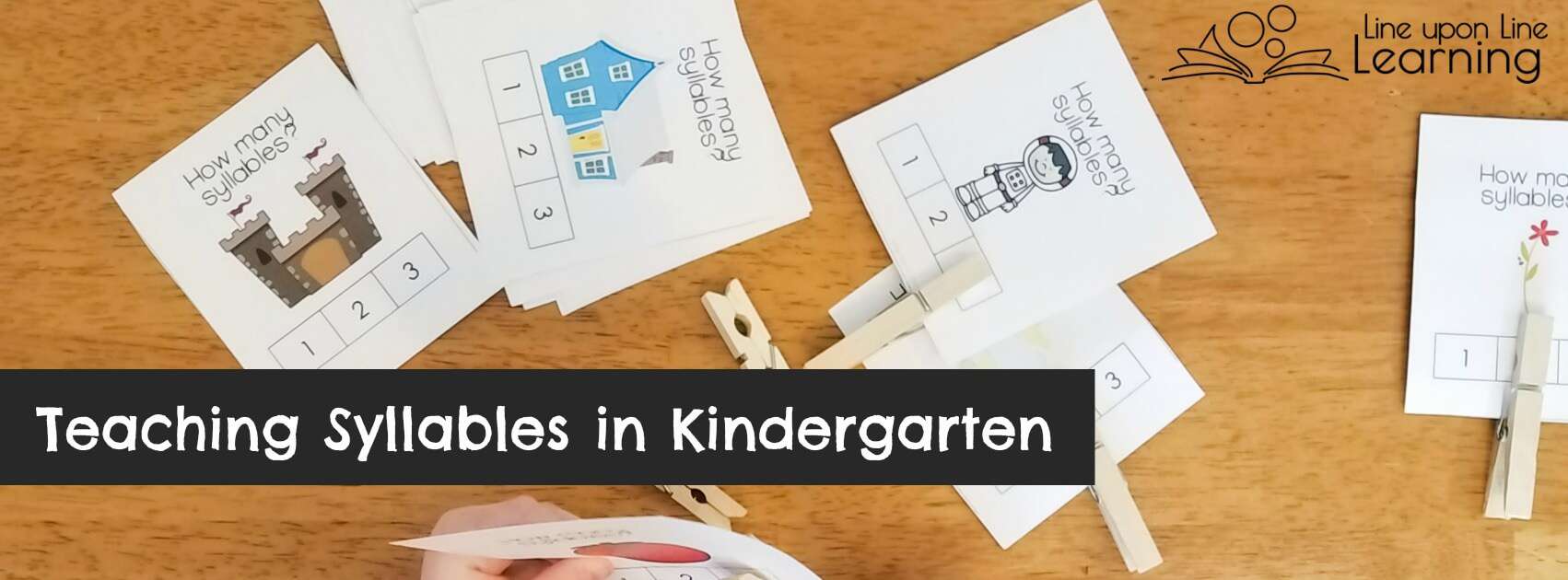


Teaching Syllables in Kindergarten with “Heartbeats”
I began working on learning the sounds of syllables by focusing on the concept of “heart beats” in words. This is just perfect for Valentine’s Day! Encourage your child to nod their head or tap each “heartbeat” for the words: pg, frog, but-ter-fly, tur-tle. Can they hear that the words have beats?
Another way to recognize the rhythm of syllables is with poems. Some kids’ picture books have a great rhythm for practicing finding these “beats.”
In my free printable, I share four fun animal and Valentine’s Day-themed worksheets. Two of them provide pictures of animals, and students draw a line from the animal to the number of heart beats (syllables) that are in it. The last two pages provide images and the student circles the number of syllables, from 1 to 3 and 1 to 4.
My daughter loved the adorable Valentine’s the animals held. But she also loved that she could easily figure out the number of syllables too.
Get access!
Free syllable worksheets
This will be sent directly to your email address!


Counting Syllables with BOOM Learning
I made a Boom™ Cards version of these animal valentines too. My daughter loves taking learning on to the computer. Teaching syllables in kindergarten is just perfect for this time of year.
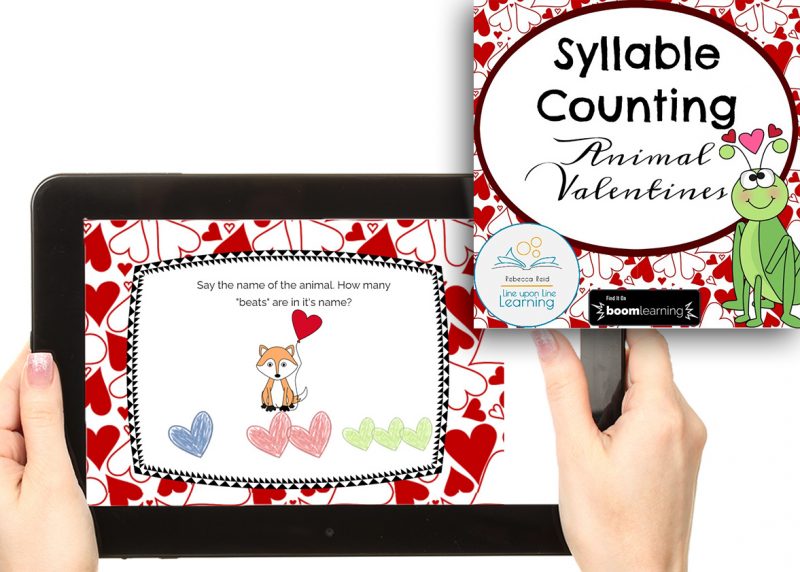
Get these digital decks from the Boom Store!
I also offer two other counting syllable decks for teachers who want to have more practice.
Are you familiar with Boom Cards?
Read my article to learn more!
Note: Boom™ is the trademark of Boom Learning. Used with permission.
More Kindergarten Syllable Activities
These worksheets are similar to a few worksheets in my larger offering about rhythm in poetry, a Picture Book Lesson plan for kindergarten or first grade teachers. Introduction to Rhythm is available at Teachers Pay Teachers and my Shop.
Picture Book Poetry: Introduction to Rhythm is more than just syllables practice. It includes all of these things!
- A lesson plan and book list, as well as a compilation of ideas for teaching the basics of rhythmic poetry to kindergarten or first graders
- Eleven pages of worksheets (some simple “draw a line” and others cut and paste activities) for students
- Three templates for creating a “silly rhythm poem”
- Two pages of public domain limericks and nursery rhymes
- Four charts for students to write their names on to declare how many syllables are in their name
Available at my Shop and TPT
My daughter and I also practiced counting syllables with my syllable counting clip cards (also at TPT). Then, I also made a few Boom Card online task card decks for syllable counting too: Syllables Counting Animal Valentines, Count the Beats Syllable Counting (to 4 syllables), and the Count the Beats Animal Theme! I think she’s got the hang of it now. Check out all the syllable counting practice I provide by browsing through my products. Shop links are provided below.
[tcb_woo_shop limit=’4′ columns=’4′ orderby=’date’ order=’desc’ paginate=’1′ cache=’false’ hide-result-count=’1′ hide-catalog-ordering=’1′ hide-sale-flash=’1′ hide-title=’0′ hide-price=’0′ hide-rating=’1′ hide-cart=’0′ hide-pagination=’1′ ids=’47428,45069,45125,45095′ category=” cat_operator=’in’ taxonomy=” terms=” terms_operator=’in’ tag=” tag_operator=’in’ align-items=’center’ ct=’shop-0′ ct-name=’Original Shop’]
Like this post? Save it for later!
Practice Recognizing Short Vowel Sounds with an Autumn Game
Strawberry may be kindergarten aged and learning to read, but she does not want to sit down and do a worksheet, thankyouverymuch. So to make sure we get a bit of school in our exploring, I have to be creative and turn it in to a game. This week we played an autumn-themed game to help us recognize the short vowel sounds. The colorful autumn cards gave it a nice seasonal twist that my daughter appreciated as we played in her Halloween costume!

Continue reading
Introducing Multi-Letter Phonograms
Now that Strawberry is gaining more confidence with the various sounds of the letters of the alphabet, she’s ready for understanding the concepts of digraphs and other multi-letter phonograms. Whistling Whales by Denise Eide introduces the 21 most important multi-letter phonograms and the multiple sounds they produce in English. After reading the picture book together, we enjoyed sorting through our sight words cards to find the phonograms we encountered in the picture book!
Continue reading
Normal Stages of Reading with a Baby or Toddler
As I’ve been through Reading 1000 Books before Kindergarten with my two oldest kids, I’ve realized that there are various “stages” of reading with children, especially reading with my babies. I started reading with my babies from their infancy, and my third child is nearly two. My thoughts on baby-reading stages are based on my personal observations of three different babies in a house that is full of book-lovers. It’s not scientific. Still, it’s a reminder that it is never to young to start reading with a baby!
When my son was a baby, I visited the library for myself mainly. On one particular day, when he was about six months old, I handed him a baby board book to hold as he sat in the stroller so he had something to hold while I searched for my book of choice. Imagine my surprise when an older lady commented, “Don’t you think he’s a bit too young?”
I’ve thought about that many times in the past 9 years. No, ma’am, I don’t think my son was too young for a book! Was he maybe too young to treat it with gentle reverence? Probably. But babies are never to young for books.

Dusty Rhyming: A Picture Book-Inspired Game
Before a child is ready to jump into learning to read, it’s important to review basic phonemic principles, such as hearing the parts of words. Rhyming is a fun activity that is ideal for kids preparing to read or just starting out. After reading a favorite picture book, we played a “Dusty” Rhyming Game to practice making our own rhymes. Continue reading
Early Reading CVC Centers
Even before my daughter could put the sounds of words together, she loved playing with words! As the months have passed, she’s become more confident in reading CVC words and these CVC activities are favorites we return to time and again.
Continue readingFlower-Themed Word Family Picture Sort
Now that Strawberry is becoming more and more aware of words and sounds and even starting to sound out consonant-vowel-consonant (CVC) words, she was very excited to try a flower-themed word family picture sort.

Strawberry loves flowers. The beautiful springtime is finally showing us tiny green buds and she cannot wait to see the blooms. For this activity, Strawberry said the name of the picture on each flower. Then, she found the matching short vowel pot to put it in. Using mini-flower pots from the gardening center and popsicle sticks and clothes pins made this word family picture sort into a multi-dimensional hands-on activity. Continue reading
Encouraging Independent Quiet Time for a Preschooler
If there is one thing my preschooler does not like, it is being alone: playing alone, resting alone, eating alone. You name it, she always wants someone right by her side to talk with her, to listen to her, and to be with her. She is an exuberant personality that loves company. Always.
I am, however, more of an introvert. Her constant company is exhausting. I love it, but it is exhausting. I’ve been working for years to try to get my no-longer-napping youngster to take an independent quiet time break each afternoon. In the past month, I’ve finally found a way to encourage independent quiet time for my preschooler: audiobooks, especially Playaways. 
Continue reading